
Loading content...
Legal information
I filed a wage complaint in Korea. What happens next?
I filed a wage complaint in Korea. What happens next?
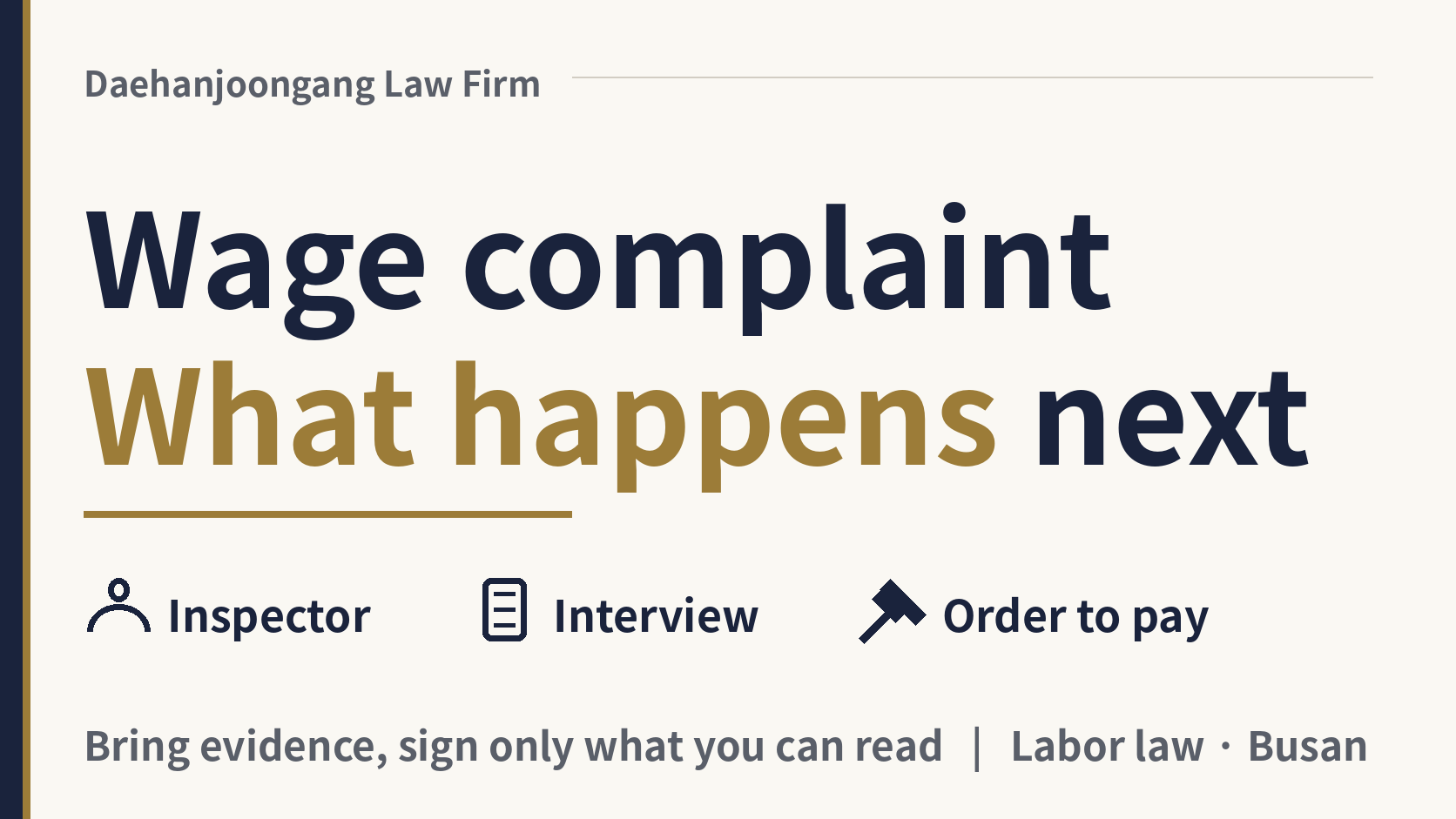
After you file a wage complaint (진정), a labor inspector (근로감독관) at the regional labor office investigates it. You will usually be contacted within a few weeks, asked to come in with your evidence, and in many cases the employer is ordered to pay by a set date. Most cases end at that stage. If the employer still does not pay, you leave with an official paper that opens the next doors.
Knowing the steps in advance helps, because the process is in Korean and moves on its own schedule.
Who will contact me, and how?
The inspector assigned to your case calls you or sends a text message. The number may look unfamiliar, so answer calls from Korean landlines in the weeks after you file. If you miss a call, call back the same day.
You can file online or in person at the labor office for the area where you worked, not where you live now. If your Korean is limited, the Ministry of Employment and Labor call center (1350) offers help in several languages, and you can ask the office in advance whether an interpreter can join your interview.
What happens at the interview?
The inspector asks both sides for their version. You explain what you were promised, how many hours you worked and what you were paid. Bring:
- your passport or residence card (외국인등록증)
- your employment contract (근로계약서), if you have one
- payslips and bank statements showing what arrived
- your own record of working hours
- KakaoTalk or text messages with the employer
Sometimes the employer and the worker are asked to attend at the same time. If you feel unsafe sitting in the same room, tell the inspector before the date. You do not have to agree to a settlement on the spot.
What if my documents are in Korean and I don't understand them?
Do not sign anything you cannot read. The written statement (진술조서) the inspector prepares becomes part of the record, so ask for it to be read back to you, through the interpreter if there is one. If a sentence is wrong, ask for it to be corrected before you sign. It is normal to ask; inspectors expect it.
How does it usually end?
| Outcome | What it means for you |
|---|---|
| Employer pays after the order | The case closes. Check the amount in your bank account before you confirm anything. |
| Employer admits the amount but does not pay | You can ask for a confirmation of unpaid wages (체불임금등 사업주확인서). With it, you can apply for government substitute payment or go to court more easily. |
| Employer disputes the amount | The inspector decides what can be confirmed. The part in dispute may need a court. |
| Employer ignores the order | The case can be sent on for criminal prosecution. This punishes the employer, but it does not by itself put money in your account. |
Should I sign a paper saying I don't want the employer punished?
Employers often offer part of the money in exchange for a signed statement that you do not want them punished (처벌불원서). Unpaid wages are, in many cases, a crime that is not prosecuted against the worker's clearly stated wishes, so this paper can end the criminal side of your case.
Sign it only after the money you agreed on has actually arrived. A promise to pay next month is not payment. And check whether the paper also says you give up the rest of your claim, because that is a different thing.
Can I leave or change jobs while the case is open?
Yes. Changing jobs does not end your complaint. If your visa depends on your workplace, the rules on changing workplaces are separate, so check them before you move.
If you might leave Korea before the case ends, tell the inspector early. Give your statement before you go and leave contact details that will still work abroad.
What about my visa?
Your complaint stays with the labor office: since November 2025, labor inspectors do not pass the worker's details to immigration, even when the worker's permitted stay has run out. A separate article explains what this covers and what it does not.
Next step
Before the interview, calculate what you are owed with the wage calculator, so you can compare it with the employer's figure. If the employer disputes the amount or stops responding, a lawyer can take the case further. Consultations are paid; when you contact us, a staff member will call you back and explain the fee.
법무법인 대한중앙
1533-7377
Rules applied
Labor Standards Act (근로기준법) Article 36 (payment within 14 days after leaving), Article 43 (full payment at least once a month), Article 49 (wage claims expire after 3 years). The procedure for complaints follows the Ministry of Employment and Labor's rules for labor inspectors.
This is general information, not legal advice. Every case is different.
Talk to an attorney about your own case
Daehanjoongang Law Firm works on the legal problem in front of you.
1533-7377
Corporate counsel
Book a consultation
Every consultation is run by an attorney who has read the file first, and it is by appointment. We book the earliest slot we can, and we ask that you keep to the time.
By phone
1533-7377
We contact you once you request a consultation