






Loading content...
Legal information
No visa, hurt at work: does industrial accident insurance cover me?
No visa, hurt at work: does industrial accident insurance cover me?
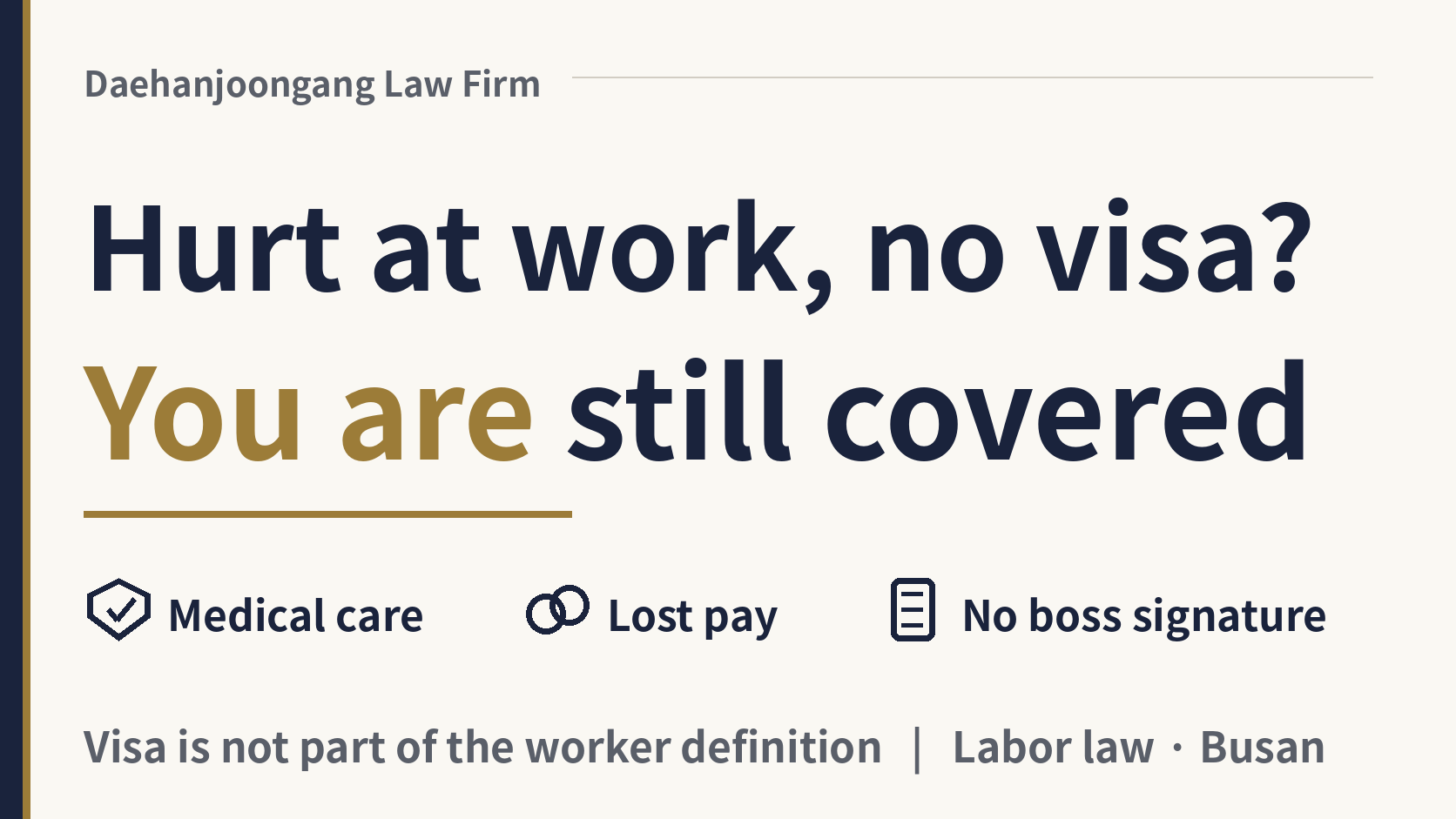
Yes. Industrial accident insurance (산재보험) covers any business with employees, and "worker" there means the same thing as under general labor law (근로기준법): a person who does work for pay. Your visa is not part of that definition. Korean courts settled this question in the 1990s, and the public insurer 근로복지공단, usually called the Workers' Compensation Service, accepts claims from workers without status.
Two things usually block injured undocumented workers, and neither is the law.
One is the employer saying "there is no insurance for you". The other is the worker going home to rest instead of going to a hospital, so that by the time anyone asks, there is no medical record.
My employer never registered me or paid premiums. Is that a problem?
As a rule, no. Coverage follows from the business employing workers, not from the employer having done the paperwork. If the employer never enrolled, the Service can still process your claim and then deal with the employer separately. Expect the employer to be unhappy about this, because it exposes both the unpaid premiums and the fact that they hired you. That is their problem to manage, not a reason for you to stay silent.
The one real exception is a small group of businesses that the insurance does not reach at all, defined by decree. Some very small farms and fishing operations run by individuals, and household work inside a private home, can fall outside. If you worked in one of those, ask before assuming you are covered.
What can I actually receive?
The insurance pays several kinds of benefits, each claimed separately.
| Benefit | What it is |
|---|---|
| Medical care (요양급여) | Treatment, surgery, medicine, rehabilitation, hospital stay, transport. Not available where three days of care or less is enough. |
| Wage replacement (휴업급여) | Seven-tenths of your daily average wage, paid for every treatment day that keeps you off work, once the first three days are past. |
| Disability benefit (장해급여) | If something permanent remains after treatment, graded by degree. A foreign national who lives outside Korea when the claim is made receives it in one payment rather than a pension. |
| Survivor benefit and funeral costs (유족급여·장례비) | Paid to the family if the worker dies. |
The average wage is the problem point for people paid in cash with no payslip. When the usual wage cannot be established, the Service falls back on a figure published by the labor ministry, so a missing payslip does not zero out your claim. Bring whatever shows what you were actually paid, because a real figure is usually higher than the fallback.
How do I file, and do I need the employer's signature?
The claim for medical care goes to the Service, not to the employer. The application lists the workplace, describes how you were injured, and attaches a doctor's opinion. The treating hospital can file it for you with your consent, and many larger hospitals have a desk that does exactly this.
Nothing requires the employer to sign your application.
If the employer refuses to confirm the accident, write your own account of what happened and name the people who saw it. The Service investigates on its own; it can visit the site and question the employer.
Until the decision comes, treatment can run through national health insurance, with your co-payment refunded later if the accident is recognized. If you are not in the health insurance scheme, which is common without status, ask the hospital's social work office (사회사업실) about payment arrangements until the decision, and hold on to every receipt. Money you paid yourself for a recognized accident can be recovered.
What matters in the first days?
- See a doctor on the day of the injury and state that it is work-related. The first medical record is the one that matters most.
- Photograph the place, the machine, the tool, the wound itself, and whoever was there.
- Send one message to the employer stating that you were injured at work, with the date and time, so the fact of the report is in writing.
- Collect contact details for every co-worker who witnessed it.
- Refuse to sign any document stating that the injury happened somewhere else, or that you accept a sum "in full settlement", until someone has read it to you.
Will the claim get me reported to immigration?
Honest answer: the November 2025 rule that protects workers who file wage complaints is written for labor inspectors investigating wage violations, and the Service is a public corporation rather than a government office with that reporting duty. We are not aware of the Service reporting injured workers, but the exemption does not name the Service, so treat this as a point to confirm rather than a guarantee. Public hospitals, for their part, are covered by an exemption when they learn a patient's status through medical care.
What is firmly written is this: the employer may not fire you, or punish you in any other way, for filing a claim. That rule applies to you as much as to anyone.
What if the Service refuses, or I have to leave Korea?
A refusal can be challenged by a review request (심사청구) to the Service within 90 days of learning the decision. Do not let that window pass while you argue with the employer.
Claims for medical care and wage replacement lapse after three years; disability, survivor and funeral claims after five.
If you leave Korea during treatment, the benefits that have already been recognized do not vanish, and disability money can be paid in one sum to a worker living abroad. Appoint someone in Korea to act for you before you go, and find out from the Service how continued treatment outside Korea will be handled, because that depends on the case.
Next step
If you are hurt and still at the site, go to the hospital first and read this later. Once there is a medical record, talk to a lawyer before signing anything the employer puts in front of you, especially if the employer offers private payment instead of insurance. Consultations are paid; when you contact us, a staff member will call you back and explain the fee.
법무법인 대한중앙
1533-7377
Rules applied
Industrial Accident Compensation Insurance Act (산업재해보상보험법) Article 5 no. 2 (worker and average wage defined by the Labor Standards Act; a figure set by the Minister applies when the wage cannot be determined), Article 6 (applies to every business employing workers, with exceptions set by decree), Article 36 (types of benefit), Article 37 (what counts as a work accident), Article 40 (medical care; none if healed within three days), Article 41 (application to the Service; the hospital may file with the worker's consent), Article 42 (health insurance applies first, co-payment refunded on recognition), Article 52 (wage replacement at 70 percent of the average wage, not for the first three days), Article 57(3) (lump sum for a foreign national living abroad), Article 103(3) (review request within 90 days), Article 111-2 (no dismissal or disadvantage for filing a claim), Article 112 (three-year and five-year limits). Immigration Act (출입국관리법) Article 84(1) and Enforcement Decree Article 92-2 no. 2 (exemption for public medical institutions). Courts have held that a worker without status is covered: 대법원 94누12067.
This is general information, not legal advice. Every case is different.
Talk to an attorney about your own case
Daehanjoongang Law Firm works on the legal problem in front of you.
1533-7377
Corporate counsel
Book a consultation
Every consultation is run by an attorney who has read the file first, and it is by appointment. We book the earliest slot we can, and we ask that you keep to the time.
By phone
1533-7377
We contact you once you request a consultation