







Loading content...
Legal information
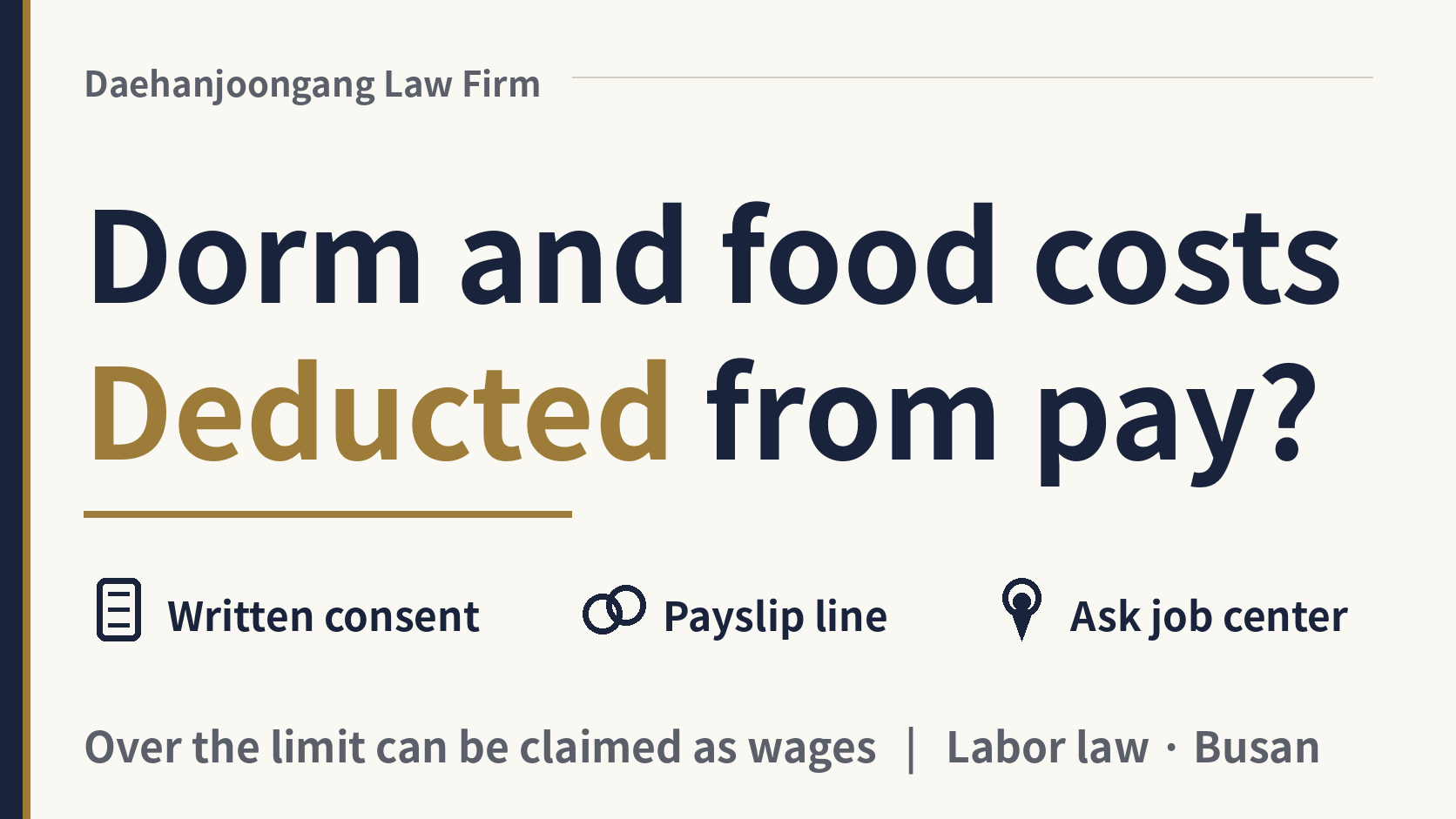
Can my employer take dormitory and food costs out of my wages in Korea?
Can my employer take dormitory and food costs out of my wages in Korea?
Only within limits, and only if you agreed to it in a way the law accepts. The basic rule is that wages must be paid in full, in money, directly to you. Taking something out before payment is an exception, so the employer has to show a legal basis for every deduction, and the amount has to appear on your payslip (임금명세서). A dormitory that is unsafe or that you never agreed to pay for is not a lawful reason to reduce your wages.
What does "paid in full" mean?
Korean law states the principle plainly: the whole wage, in currency, to the worker. An employer who wants to hold part of it back needs one of two things.
| Basis for a deduction | Example |
|---|---|
| A law or regulation | Income tax, national health insurance, pension, employment insurance |
| A collective agreement with a union | Union dues at a unionized factory |
Room and board are not on this list by themselves. In practice, employers rely on the worker's own consent, written into the employment contract (근로계약서) or a separate form, and labor offices generally accept a deduction that the worker clearly and freely agreed to. That is why the signature matters so much: without it, the employer is on weak ground.
How much can they take for housing and meals?
The labor ministry (고용노동부) has published guidance (고시) on how much an employer may charge foreign workers for dormitories and meals, and the limit depends on the kind of housing. We do not quote figures here because the guidance changes and the numbers depend on your situation. What you can do:
- Ask the job center (고용센터) what the current limit is for your type of housing, for example a container, a converted building, or an apartment.
- Compare that limit with the line on your payslip.
- If the deduction is higher than the limit, or if the housing is worse than what was described, the difference can be claimed back as unpaid wages.
A charge for a container on a farm and a charge for a room in a proper building are not supposed to be the same.
What must the employer tell me before I sign?
When an employer provides a dormitory to a worker hired through the permit system (고용허가제), the law requires certain information to be given before the contract is signed, and again if anything changes:
1. the structure and facilities of the dormitory 2. where it is located 3. the living environment 4. the floor area 5. other matters needed to run the dormitory
If you were shown photos of one place and moved into another, or if the room has no heating, no lock, or no separate bathroom, write down what was promised and what you got. The dormitory must also meet the general standards that Korean labor law sets for company housing.
What should I look for on my payslip?
Every time you are paid, you have the right to a written payslip, and it must list each deduction with its reason. Check these points each month:
- Is the dormitory charge the same amount you agreed to?
- Is the meal charge counted per month, or per meal you actually ate?
- Are there deductions with no name, or named only "etc." (기타)?
- Does the total match what reached your bank account?
Keep the payslips, even as phone screenshots. If you never received a payslip, that itself is a violation you can mention when you report.
What is never allowed?
Some deductions are prohibited no matter what you signed:
- Penalties for quitting. A contract that fixes an amount you owe if you leave early is void.
- Advances or "loans" tied to your job. The employer cannot set off money it says you borrowed against your wages.
- Forced savings. The employer cannot hold part of your pay as "savings" that you cannot access.
- Deductions for damage decided by the employer alone, such as a broken tool or a lost uniform, without a court or agreed procedure.
If you see any of these on your payslip or in your contract, that part of the contract has no effect, and the money can be claimed.
What can I do if the deduction is too high?
Start by asking the employer, in writing, to show you the basis for the deduction. Many disputes end here. If not:
1. Collect your contract, payslips and bank statements for every month in question. 2. Photograph the dormitory, inside and outside, with the date visible. 3. Report to the regional labor office (지방고용노동청) as an unpaid wage case. The deduction above the limit is treated like a wage that was not paid. 4. If the housing itself breaks the rules, mention it at the job center as well. Housing that violates the standards is one of the reasons that lets an E-9 worker move to another employer without using up a change.
Unlawful deductions can also be claimed after you leave the company, within the ordinary time limit for wage claims.
Next step
Put your last three payslips next to your contract and mark every deduction you did not agree to or do not understand. If the amount is significant, talk to a lawyer before you confront the employer. Consultation fees apply; a staff member will contact you to explain them before any meeting.
법무법인 대한중앙
1533-7377
Rules applied
Labor Standards Act (근로기준법) Article 43(1) (wages paid in full, in currency, directly; deductions only under a law or collective agreement), Article 48(2) (written payslip showing deductions), Article 100 (standards for company dormitories), Article 20 (no penalty clauses), Article 21 (no set-off of advances), Article 22 (no forced savings), Article 15 (contract terms below the legal standard are void). Act on the Employment of Foreign Workers (외국인근로자의 고용 등에 관한 법률) Article 22-2 (dormitory information to be given before the contract), Article 25(1)2 (housing that violates Article 22-2 as a reason for workplace change).
This is general information, not legal advice. Every case is different.
Talk to an attorney about your own case
Daehanjoongang Law Firm works on the legal problem in front of you.
1533-7377
Corporate counsel
Book a consultation
Every consultation is run by an attorney who has read the file first, and it is by appointment. We book the earliest slot we can, and we ask that you keep to the time.
By phone
1533-7377
We contact you once you request a consultation