







Loading content...
Legal information
I moved to a new address in Korea. What do I have to report?
I moved to a new address in Korea. What do I have to report?
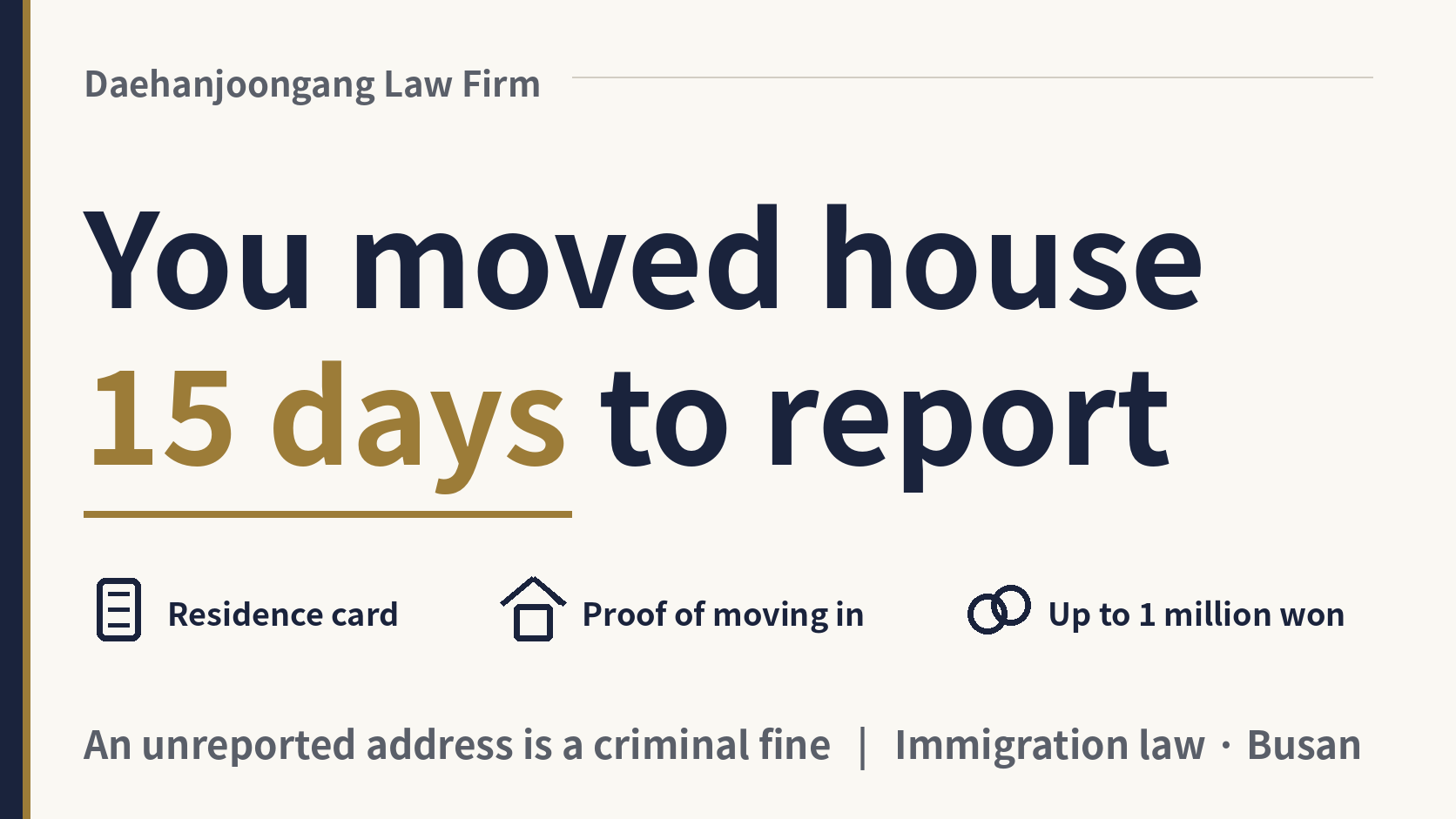
Report the move within 15 days of the day you moved in. You can file at the 시·군·구 or 읍·면·동 office for your new address, or at the immigration office (출입국·외국인관서) that covers it, and you hand over your residence card (외국인등록증) so the new address can be written on it. Missing that deadline is not a paperwork slip: an unreported address change carries a criminal fine of up to 1 million won. Changes to your name, nationality or passport are a different report with its own 15 day limit and an administrative fine of up to 1 million won.
Which report is which?
| What changed | Where it goes | Limit | If you do not file |
|---|---|---|---|
| Your address in Korea | 시·군·구, 읍·면·동, or the immigration office for the new address | 15 days from moving in | Fine of up to 1 million won |
| Name, sex, date of birth, nationality | The immigration office for your address | 15 days | Administrative penalty of up to 1 million won |
| Passport number, issue date, validity | Same | 15 days | Same |
| Items the ministry adds for your status | Same | 15 days | Same |
The difference between the two bottom rows and the top one matters more than it looks. A criminal fine is an outcome in a criminal case, and immigration asks about your record when you apply for an extension or a change of status. An administrative penalty is money, not a record of that kind.
Which extra items apply to my status?
The ministry list is written status by status, so read your own line:
- D-1, D-2 and D-4 to D-9 holders: a change of the organisation you belong to, including a change of its name, or the addition of one.
- D-2 students: a change in whether you are enrolled.
- D-10 job seekers: starting a traineeship, or changing the institution where you do it.
- H-2 holders: your first employment with a person, body or company, and later any change of that employer.
- D-7 to D-9 holders and certain investment and residence categories: a change of occupation or of annual income.
For statuses that allow employment, moving to a new workplace is not a report at all: permission has to be obtained in advance, except for certain professionals who instead notify within 15 days of the change. Your employer has its own separate duty to notify within 15 days when you are dismissed, resign, or cannot be located, or when an important term of the contract changes. The employer's filing does not replace yours.
What do I bring for the address report?
- Your residence card. The office writes the new address on it and gives it back. If you hold the mobile version of the card, the change can be recorded there instead when you file through the electronic civil service window.
- The change of address form used by whichever office you go to.
- Proof that you actually moved in: your lease, a purchase contract, or another document accepted as showing the move.
Take a photograph of the updated card the same day. It is the document a bank, a hospital or a school will ask to see, and you will need to show a consistent address when you apply to extend your stay.
Why does an unreported address cause so much trouble?
Because the address on your registration is the address the state writes to. Court papers, a police request to attend, insurance notices and immigration letters are sent there, and in Korean. A letter that no one collects can still count as delivered in some procedures, and a deadline you never saw is still a deadline you missed. Officials may also investigate when they have reason to think a registration or a report does not match the facts; an address left wrong for a year is hard to explain.
Who files for a child, or if I cannot go myself?
For a person under 17 who does not file in person, a parent or another person named in the regulations has to do it, and that covers the address report, the registration change report, and applications to extend or change status. Certain filings, such as the employer's notification and some applications, can be handled by an authorised agency on your behalf. The address report asks for your card, so plan on attending unless the office tells you otherwise.
What happens to my card when I leave Korea?
You hand the card to the immigration officer on departure, unless you are going out temporarily and will return within a re-entry permit, within the period allowed to nationals of countries exempt from that permit or to holders of a multiple entry visa, or within the validity of a refugee travel document. If you do not come back inside that period, your registration can be closed, and reopening it is not a formality. Decide before you book which of these cases you are in.
Next step
Put three dates side by side: the day you moved in, the day you filed, and the day your current permission expires. If a gap in that line is already longer than 15 days, say so at the consultation rather than at the counter, so the order of your filings can be planned. Consultations carry a fee, and our staff will explain it when they return your call.
법무법인 대한중앙
1533-7377
Rules applied
Immigration Act (출입국관리법) Article 36(1) (address change reported within 15 days of moving in, to the 시·군·구 or 읍·면·동 head for the new address or to the head of the local immigration office), (2) (residence card submitted and returned with the change entered) and (8) (mobile residence card through the electronic civil service window), Article 35 (name, sex, date of birth, nationality, passport number, issue date and validity, and items set by ministerial rule, within 15 days), Article 33(6) (mobile residence card), Article 37(1) (card returned on departure, with the re-entry permit, multiple visa or exemption, and refugee travel document exceptions), Article 37-2(1) (closing a registration), Article 21(1) (prior permission to change or add a workplace; notification within 15 days for persons specified by decree), Article 19(1) (employer's notification within 15 days), Article 79 (parent or other person files for a person under 17), Article 79-2(1) (filings an authorised agency may handle), Article 80(1) (investigation where a report or registration is suspected not to match the facts), Article 98 item 2 (fine of up to 1 million won for breach of Article 36(1)), Article 100(2) item 1 (administrative penalty of up to 1 million won for breach of Article 35 or 37). Enforcement Rule (출입국관리법 시행규칙) Article 49-2 (items added by ministerial rule, by status), Article 49-3(1) and (2) (forms by office, and the lease, purchase contract or other document showing the move).
This is general information, not legal advice. Every case is different.
Talk to an attorney about your own case
Daehanjoongang Law Firm works on the legal problem in front of you.
1533-7377
Related articles
- I study in Korea and do delivery work. Can I be deported for it?
- Immigration handed me a fine notice: pay it, or be sent to court?
- My Visa Extension Was Refused. What Can I Do?
- Held in an immigration detention centre: how do you get released?
- I work on a farm or fishing boat in Korea. Why is there no overtime pay?
- I have no visa and worked over a year. Am I owed severance pay?
- I was hurt at work in Korea. Who pays the hospital and my wages?
- My E-9 work period is ending. Can I work in Korea again?
All legal information →Legal information: everything from November 2026 →
Corporate counsel
Book a consultation
Every consultation is run by an attorney who has read the file first, and it is by appointment. We book the earliest slot we can, and we ask that you keep to the time.
By phone
1533-7377
We contact you once you request a consultation