














Loading content...
Legal information
My stay extension was refused: how long do I have to challenge it?
My stay extension was refused: how long do I have to challenge it?
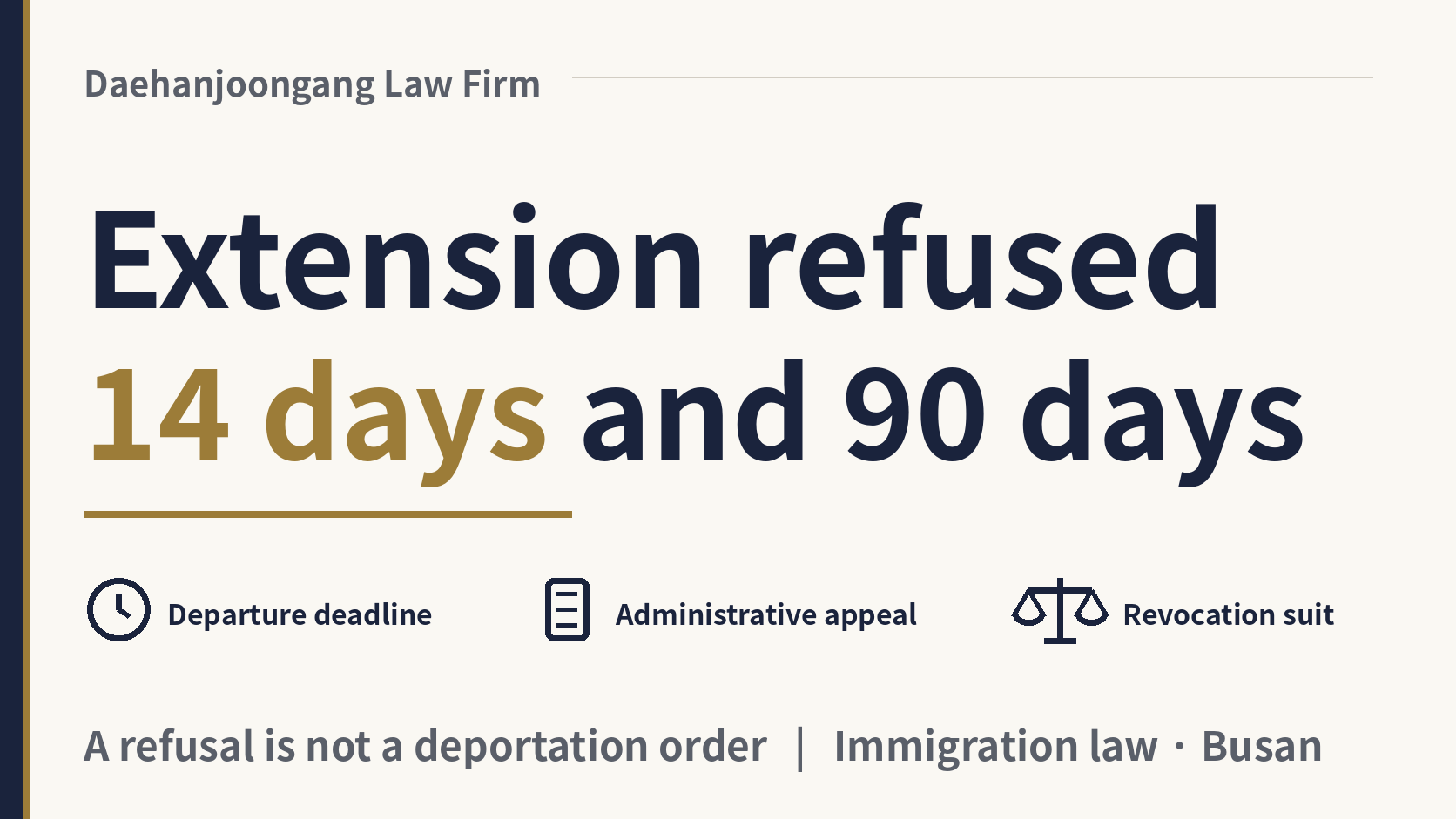
Look at the form the office gave you. If a departure deadline is printed on it, that date is not more than 14 days from the day the form was issued. Two longer clocks are running from the same day: 90 days to file an administrative appeal, and 90 days to bring a revocation suit in court. The 14 days decide where you will be standing while those 90 days run, so start with the form.
Read the refusal form before anything else
Where the Minister of Justice does not grant a status grant, a change of status or an extension of the stay period, the applicant must be told on a prescribed form. That form has to state a departure deadline clearly, and the deadline cannot be more than 14 days from the day it is issued, although the Minister may instead use the expiry date of the stay already permitted. There is one case where no such date appears. Where a change of status is refused, the person may be allowed to remain on the status they already hold, and the form then need not state a departure deadline at all.
So read for three answers: which application was refused, whether a departure date is printed, and whether the form lets you stay on your existing status. Those three answers put you in a completely different position from the person who was sitting next to you in the waiting room.
A refusal is not a deportation order. Nobody is being removed on the strength of this paper. But remaining past the date printed on it, or past your permitted period, is an offence in its own right: carrying on the activities of another status without a change permission, and staying beyond the period without an extension, each carry up to 3 years in prison, or a fine reaching 30 million won.
What goes wrong before the refusal
Two timing rules cause most of the refusals that are hardest to argue afterwards.
The application to extend must reach the office while your current period is still running. Not afterwards, and not while the paperwork is still being assembled.
Permission to change status must be in hand first, before you begin the activities that belong to the new status. And where a registered foreigner's personal circumstances have changed, the change of status must be obtained within 30 days of the day that change occurred. A marriage, a divorce, the end of a course of study and the end of an employment relationship are all the kind of change that sets those 30 days running.
The application itself goes to the head of the local immigration office, which forwards it with its own opinion to the Minister. Where permission is given, the passport is stamped or a sticker is affixed, or the residence card (외국인등록증) is issued or reissued instead. The review standards for a change of status live in ministerial rule rather than the Act's own text, which is part of why two offices can weigh similar facts differently.
The two routes, and their deadlines
| Route | Deadline | Outer limit |
|---|---|---|
| Administrative appeal (행정심판) | 90 days from the day you became aware of the disposition | No appeal once 180 days have passed since the disposition was made, unless there is a justifiable reason |
| Revocation suit (취소소송) in the administrative court | 90 days from the day you learned of the disposition, counted from service of the certified copy of the ruling where you appealed first | No suit once 1 year has passed since the disposition, unless there is a justifiable reason |
All of those are fixed periods (불변기간). A fixed period does not stretch because the notice was in Korean, or because you were waiting for a lawyer to become available, or because somebody at the counter said something different on the telephone.
Two openings are built into the appeal rule, and both matter to a person who may already be on a plane. Where force majeure prevented filing, the appeal may be brought within 14 days of the day the obstacle ended, and within 30 days where it is filed from outside Korea. And where the authority did not state the appeal period in its notice, the 180-day limit applies instead of the 90 days.
If the deadline makes you leave
Going home within the departure deadline and challenging from there is a real option rather than a surrender, and the 30-day window for an appeal filed from outside Korea exists for precisely that situation. It is also the slower road: documents, service of decisions and any later application all take longer from abroad. Whether filing an administrative appeal holds off the 14-day departure deadline in practice is not something to assume either way. Ask that question directly, because the answer decides whether you pack.
What a second attempt costs
Reapplying is often quicker than fighting, and the fees are published, so work them out before the trip to the office, not while standing at the counter.
- Permission for activity outside your status: 120,000 won, reduced to 20,000 won where the Minister so recognises, as with part-time work by a D-2 or D-4 holder
- Change or addition of a workplace: 120,000 won
- Grant of status: 80,000 won, or 40,000 won for F-6
- Change of status: 100,000 won, or 200,000 won for F-5
- Extension of the stay period: 60,000 won, or 30,000 won where the holder has F-6
Putting the file together
Line up three dates in order: the day the form was issued, the departure deadline printed on it, and the expiry of the stay you were last permitted. Next to them, write the reason the office gave, word for word, even if you only had it read to you over the phone. That reason is what an appeal or a suit has to answer, and a refusal recorded as nothing more than requirements not met needs the file behind it before anyone can say whether it is worth challenging. We bill for advice. You will hear the price from our staff before an appointment is made.
법무법인 대한중앙
1533-7377
Rules applied
Immigration Act (출입국관리법) Article 24(1) (prior permission to change status), (2) (a person listed in Article 31(1) whose personal circumstances have changed must obtain the change of status within 30 days of the day the change occurred) and (3) (review standards set by ministerial rule), Article 25 (extension of the stay period), Article 94 items 16 and 17 (carrying on activities of another status without a change permission, and staying beyond the period without an extension: up to 3 years' imprisonment or a fine of up to 30 million won). Enforcement Decree (출입국관리법 시행령) Article 30 (the application goes to the head of the 출입국·외국인관서, which forwards it with an opinion to the Minister; passport stamp or sticker, or issue or reissue of the residence card), Article 31(1) (an extension must be applied for before the current period ends), Article 33(1) (notice on the prescribed form where a status grant, a change of status or an extension is not granted, and a person refused a change may be allowed to remain on the status already held) and (2) (the form must state a departure deadline clearly, not more than 14 days from the date of issue, although the Minister may instead use the expiry date of the stay already permitted, and no deadline is needed where the person may remain on the existing status). Enforcement Rule (출입국관리법 시행규칙) Article 72 (the fees listed above). Administrative Appeals Act (행정심판법) Article 27(1) (90 days from the day the person became aware of the disposition), (2) (force majeure: 14 days from the end of the obstacle, 30 days where filed from outside Korea), (3) (180 days from the disposition, unless there is a justifiable reason), (4) (both are 불변기간, fixed periods) and (6) (the 180-day period applies where the appeal period was not stated). Administrative Litigation Act (행정소송법) Article 20(1) (90 days, counted from service of the certified copy of the ruling where an administrative appeal was taken), (2) (1 year from the disposition, unless there is a justifiable reason) and (3) (also a fixed period).
This is general information, not legal advice. Every case is different.
Talk to an attorney about your own case
Daehanjoongang Law Firm works on the legal problem in front of you.
1533-7377
Related articles
- F-5 permanent residence: what ends it, and why the card expires
- I study in Korea and do delivery work. Can I be deported for it?
- I moved to a new address in Korea. What do I have to report?
- Immigration handed me a fine notice: pay it, or be sent to court?
- Held in an immigration detention centre: how do you get released?
- My Visa Extension Was Refused. What Can I Do?
- I was hurt at work in Korea. Who pays the hospital and my wages?
- Injured at work in Korea: what to do on the very first day
All legal information →Legal information: everything from November 2026 →
Corporate counsel
Book a consultation
Every consultation is run by an attorney who has read the file first, and it is by appointment. We book the earliest slot we can, and we ask that you keep to the time.
By phone
1533-7377
We contact you once you request a consultation